
Introduction
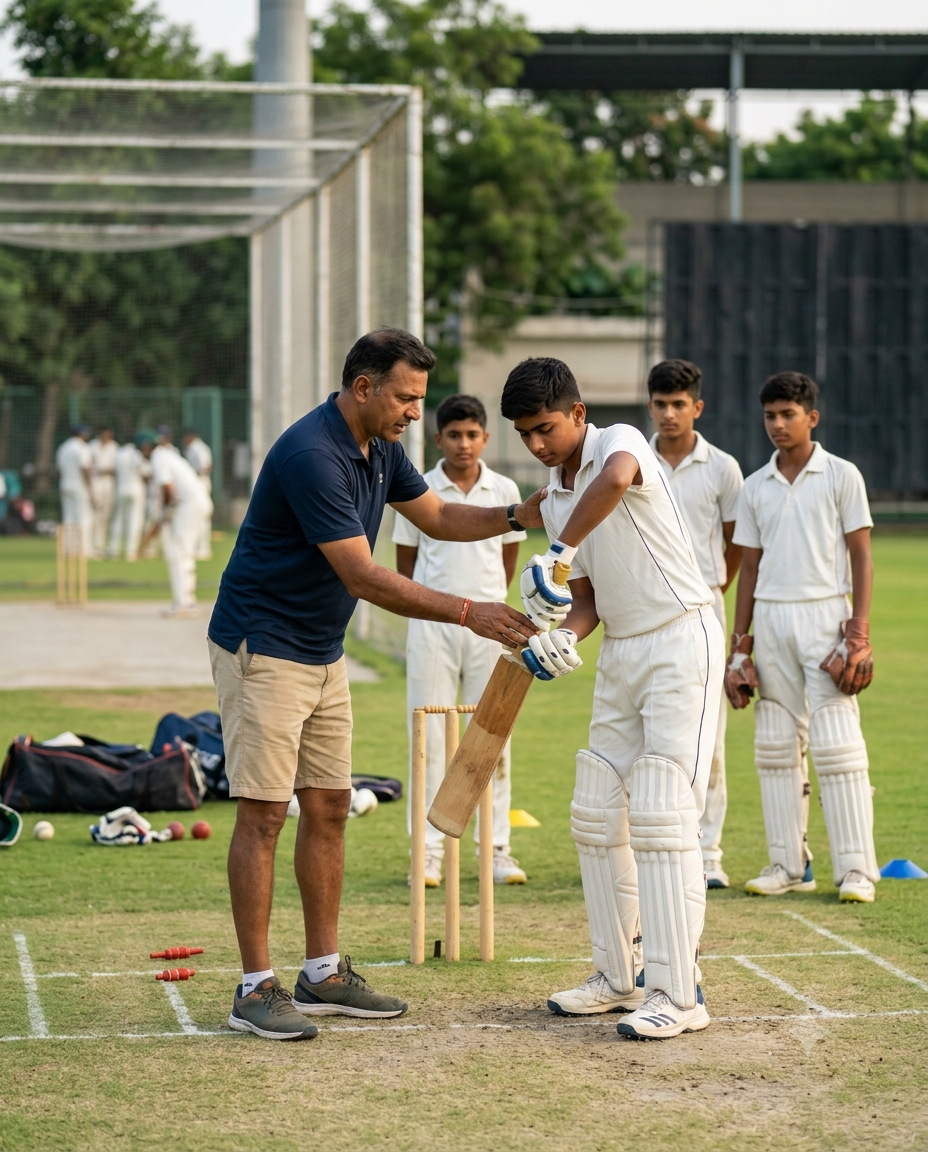
Batting is not only about scoring runs. For young cricketers, strong batting starts with the right technique, balance, timing and regular practice.
The best way to develop these skills is through focused drills that allow players to repeat important movements and gradually build confidence at the crease.
In this article, we explore five practical batting drills that young cricketers can include in their regular training sessions.
1. Front-Foot Drive Drill
The front-foot drive is one of the most important attacking shots in cricket.
This drill helps young players develop a stable base, correct head position and controlled bat swing.
How to Practice
- Start in your normal batting stance.
- Ask a coach or partner to feed gentle balls on a good length.
- Move your front foot towards the ball.
- Keep your head over the front knee.
- Play the shot with a straight bat.
- Focus on balance after completing the stroke.
Key Focus
Balance • Head Position • Straight Bat • Timing
2. Back-Foot Punch Drill
The back-foot punch helps players become comfortable playing deliveries that are slightly shorter in length.
It develops footwork, hand-eye coordination and controlled attacking strokes.
How to Practice
- Begin from your normal batting stance.
- Practice moving quickly onto the back foot.
- Keep your eyes on the ball.
- Transfer your weight smoothly.
- Play the shot with controlled hands.
- Finish balanced and ready for the next delivery.
Key Focus
Footwork • Timing • Hand-Eye Coordination • Control
3. Batting Defence Drill
A strong defensive technique gives young cricketers confidence against good bowling.
The goal is not to hit the ball hard. Instead, the focus is on presenting the bat correctly and controlling the ball.
How to Practice
- Start with a comfortable batting stance.
- Watch the ball carefully from the bowler’s hand.
- Move towards the line of the delivery.
- Keep your head steady.
- Bring the bat down with soft hands.
- Focus on keeping the ball close to the ground.
Key Focus
Judgement • Head Position • Soft Hands • Bat Control
4. Throw-Down Reaction Drill
Throw-downs are an excellent way to develop batting rhythm and reaction speed.
A coach or training partner can gradually change the length and direction of deliveries while the player focuses on making quick decisions.
How to Practice
- Start with controlled throw-downs.
- Ask the feeder to vary the length.
- Watch the ball closely.
- React according to the length.
- Focus on selecting the correct shot.
- Gradually increase the speed of the throw-downs.
Key Focus
Reaction • Decision Making • Shot Selection • Timing
5. Target Batting Drill
Target batting turns practice into a measurable challenge.
Instead of simply hitting the ball, players aim for specific areas of the field.
How to Practice
- Place targets in different scoring areas.
- Choose a specific shot for each target.
- Begin with controlled deliveries.
- Try to hit the selected target consistently.
- Record your successful attempts.
- Gradually increase the difficulty.
Key Focus
Accuracy • Shot Selection • Consistency • Game Awareness
Why Regular Batting Drills Matter
Young cricketers improve when they practise with purpose.
Repeating the right movements helps players develop consistency while structured drills allow coaches to identify technical areas that need improvement.
The objective should not always be to practise for longer. It should be to practise with better focus and clear goals.
Final Thoughts
Good batting technique develops over time through quality coaching, consistent practice and match experience.
By including focused drills such as front-foot drives, back-foot punches, defensive practice, reaction throw-downs and target batting, young cricketers can build a stronger foundation for their game.
At Excellence Sports Academy, the goal is to help players develop their skills with purposeful training, structured practice and continuous improvement.